
Public Charge Rule
New Info for 2026
Public Benefits Can Affect Green Card Applications
Public Benefits Can Affect Green Card Applications
Some people who apply for a green card (lawful permanent resident status) or a visa to enter the U.S. must pass a “public charge” test. This test looks at whether the person is likely to depend mainly on government services now or in the future; if they are, they are considered a “public charge.” Immigration officials look at all of a person’s circumstances, including their age, income, health, education or skills, and family situation. If the government determines that an applicant could be a “public charge” and likely to rely on government services, their application may be denied.

The federal Department of Homeland Security (DHS) is changing what public benefits they can look at when deciding whether someone applying for a green card may become a “public charge.”
Under the old rule, only two types of public benefits could be considered: cash programs, like SSI and TANF, and long-term institutional care paid for by the government, like Medicaid paying for a stay in a nursing facility or mental health institution. After the change, DHS will be able to consider any “means-tested” public benefit. “Means-tested” means that only people below a certain income can get the benefit. In addition to SSI and TANF, means-tested public benefits include Medicaid, Alliance, and SNAP.
Under the old rule, DHS also only looked at whether the person applying for a green card got public benefits; the agency did not consider benefits received by family members. Under the new rule, DHS is able to consider whether someone’s family members receive public benefits. For example, if a parent applies for a green card, DHS may consider whether their child--including a child who is a U.S. citizen--receives Medicaid.
DHS is planning to issue more guidance explaining these changes and how they will be implemented.
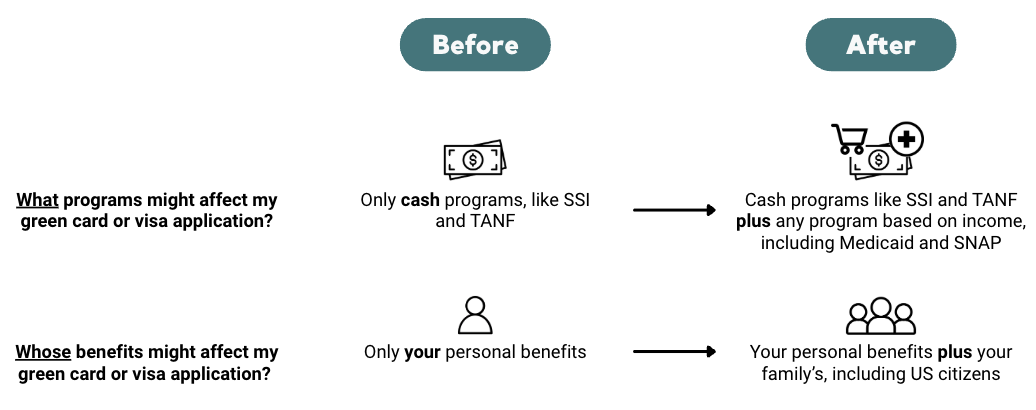
The change goes into effect September 18, 2026. This means that:
- It should not apply to anyone who applies for a green card before September 18, 2026.
- Up until September 18, 2026, DHS should only consider cash assistance and long-term institutionalization at government expense.
WHO the Public Charge rule applies to is NOT changing. It does not apply to:
- U.S. citizens;
- People with green cards who are renewing them or applying to become a U.S. citizen (although it may apply if you leave the country for more than six months); and
- People with TPS, a U or T visa, Asylum or Refugee status, or Special Immigrant Juvenile Status (although it may apply if you apply for a family-based green card).
DHS will still NOT consider the receipt of benefits that are not means-tested. This includes:
- Unemployment benefits;
- Medicare;
- Social Security Disability Insurance, or SSDI; and
- Use of public schools and public libraries.
Receipt of public benefits is still only one part of what DHS must consider in deciding whether someone is likely to be a “public charge.” Immigration officials will still look at all of a person’s circumstances, including their age, income, health, education or skills, and family situation.
Because this new policy is complicated and every family is different, you should talk with an attorney before making a decision about applications or benefits.
Updated August 2026