
Debt Collection Guide
Debt Collection Cases in DC
Debt Collection Cases in DC
This guide tells you what to do when you have been sued by a person or business that is attempting to collect a debt. Each section has information about a step in the debt collection case process. It also includes information about your rights and organizations that may be able to help you.

This guide tells you what to do when you have been sued by a person or business that is attempting to collect a debt. Each section has information about a step in the debt collection case process:

This packet does not contain information about other types of court cases, including cases in which an insurance company sues a person who was in a car accident. For help with a car accident case, you can call the DC Resource Bridge at 202-933-HELP (4357).
The court has a special “debt collection calendar.” Most debt collection cases filed by banks, credit unions, medical providers, landlords, and others involve “consumer debts” and are put on this calendar. A consumer debt is money you owe because you bought goods or services or got a loan for personal, family, medical, or household purposes or you owe rent for a residential lease.
The calendar is presided over by a Magistrate Judge. You have a right to have your case heard by an Associate Judge (a higher-level judge). If you want a jury trial, you must request an Associate Judge. Most people who are sued agree to have their case heard by a Magistrate Judge.
Almost all hearings are “remote.” That means you can participate by telephone or video instead of having to go to the courthouse. Most court notices and orders explain how to connect remotely. If you prefer to participate in person, you can go to Courtroom 205 in the Moultrie Courthouse at 500 Indianna Ave. NW.
If you have been sued by someone who is attempting to collect a debt, you are the “defendant” in the case. There are organizations and resources available to provide advice and possibly representation in your case. Some organizations are limited in who they can assist based on your income, age, or where you live. This section will identify the resources available to you and explain who is eligible for each resource. For most people (regardless of income), the best place to start is the DC Resource Bridge at 202-933-HELP (4357) (see below).
Legal Aid DC
Legal Aid DC represents consumers in cases involving all forms of consumer debt, including credit card debt, personal loans, condo and homeowners’ association fees, rental debt, and medical debt. They also accept cases in which the defendant is sued by an insurance company after a car accident. You can apply for Legal Aid DC’s services online and get information about inperson intake hours at www.legalaiddc.org/help.
Tzedek DC
Tzedek DC offers free legal services to both low-income and moderate-income DC residents with debt and other consumer legal issues. You can contact Tzedek DC by calling (202) 274-7386 or by filling out the contact form found on their website at www.tzedekdc.org/legal-services-contact-us.
Neighborhood Legal Services Program
The Neighborhood Legal Services Program (NLSP) assists low-income DC residents with a variety of consumer law issues such as debt collection, unfairness in consumer matters, credit reporting issues, identity theft, fraud, scams, student loans, predatory lending, and more. You can apply for NLSP’s services online at www.nlsp.org, by phone at (202) 832-6577, or by walking into one of their two offices (64 New York Ave. NE, Suite 180 or 4609 Polk St. NE) during intake hours.
Legal Counsel for the Elderly
Legal Counsel for the Elderly (LCE) provides free help to DC residents 60 years of age and older with a variety of legal issues including debt collection. You can apply 3 for LCE’s services on their website at www.aarp.org/legal-counsel-for-elderly/ or by contacting their Legal Hotline at (202) 424-2120.
DC Refers
DC Refers is an online directory of lawyers and mediators who are willing to assist with legal matters at reduced rates ($150.00 an hour or less). If you fall outside of their income guidelines, you can still use their services to locate a lawyer that may be able to assist with your legal matter, but you may need to pay higher rates. Private lawyers set their own rates, and you should always ask what they charge. You can get more information or find a lawyer at http://www.dcrefers.org/.
The DC Resource Bridge
The DC Resource Bridge is an easy way for DC residents to get connected with legal help. This includes matters related to debt, foreclosure, and other financial issues. Their number is 202-933-HELP (4357). When you call, they will ask about your situation and try to match you with the best organization or service to get you the help you need.
DC Bar Consumer Law Resource Center
The DC Bar Consumer Law Resource Center provides free legal help for people dealing with debt collection, home improvement or independent contractor disputes, security deposit refunds, small claims cases, used car or car repair disputes, and utility disputes, among other issues. The Consumer Law Resource Center is open every other Monday. An up-to-date schedule of future clinic dates can be found on their website at www.dcbar.org/Pro-Bono/Free-Legal-Help/Help-for-Individuals. You can also call (202) 780-2574 (ext. 2574) for more information.
DC Bar Advice & Referral Clinic
The DC Bar Advice & Referral Clinic provides a free opportunity to discuss your legal issues, including debt collection issues, with a volunteer lawyer. The clinic is hosted once per month. A schedule and the location of upcoming clinics can be found on their website at www.dcbar.org/Pro-Bono/Free-Legal-Help/Help-forIndividuals.
Law Help DC
Law Help DC is a free source of legal information about legal rights, what steps to take in your legal problem, and where to find local resources for getting legal help. Their website is www.lawhelp.org/dc, and you can find bankruptcy and debt collection information at www.lawhelp.org/dc/issues/consumer/bankruptcy-debtcollection.
Most cases on the court’s Debt Collection Calendar are cases in which a bank, credit union, landlord, condominium association, or other creditor is trying to collect what is known as a “consumer debt.” That means that the debt involved something that was for personal or household purposes (and not something for a business). Persons who owe such debts are called “consumers.”
The D.C. Debt Collection Act protects consumers from unfair and abusive ways of trying to collect a debt. For example, a debt collector might call you at odd hours or call or text you many times a week or even threaten you in some way. These kinds of aggressive actions are illegal.
The Act also protects consumers when the creditor files a court case against them. The law requires the company suing you to provide information about who they are, the nature of the debt, the contract or other evidence of the debt, an account history, and other valuable information.
The Debt Collection Act tells original creditors and their debt collectors that they cannot use threats or harassment to try to collect a debt. They also cannot use unfair or deceptive practices. The Act lists many specific unfair and abusive practices that violate the law.
If the company that attempted to collect the debt before your court case was filed did so in a way that seemed unfair, harassing, or abusive, that may give you a defense in your case, or even your own counterclaim against the business or its debt collector.
The Debt Collection Act also requires the company suing you to provide certain information and documents in their Statement of Claim or Complaint. For example, they must tell you exactly what debt they are suing you for and the basis for any interest or attorneys’ fees they are seeking. They must also provide a copy of the contract or document they are relying on to sue you and an itemized account statement.
In addition, the law requires the company to include a notice explaining that you may have income or resources that are protected from being taken from you and a phone number to call to get free legal help.
If the company does not comply with these court process protections, you have both a defense and a claim against the company. You should consider consulting with a lawyer in this situation.
The “plaintiff” (the party suing you) must give you a copy of the court papers. For a small claims case, that will include the Statement of Claim. For a civil actions case, the papers will include the Complaint (more about these two types of cases below). Usually, the plaintiff sends a person called a “process server” to your door to give you the papers. They can give the papers to you or a person who lives with you. They cannot leave the papers with someone who does not live with you.
Another way the plaintiff can serve you is by certified mail (return receipt requested) if you sign the return receipt.
Sometimes, after trying to serve you at home or by certified mail, a plaintiff may ask the court to allow them to serve you another way — for example, by sending you the papers in an email and by regular mail. This is called “alternative service” or “service by alternative means.”
After the plaintiff serves you, the person who made the service is required to file a paper saying how they served you. The paper is called an Affidavit of Service.
The plaintiff in your case gives the court your address (which may or may not be current). The court will send you notices of hearings and orders in your case at the address the plaintiff provided. You may get one of these notices or orders from the court before you are served with the Statement of Claim or Complaint. You are not required to attend hearings or file papers in the case just because you received a court notice. You can wait until you are formally served with the Statement of Claim or Complaint. But you can “waive” (give up) that right if you want the case to go forward without waiting to be served.
If you want to know more about the case before you are served, you can get a copy of the Statement of Claim or Complaint by using the case search feature on the court’s website at https://www.dccourts.gov/ or going to the Clerk’s Office.
Your next steps depend on whether the case was filed in the court’s Small Claims Branch or Civil Actions Branch.
In a small claims case
You can tell that your case is a small claims case if the case number has “SCB” in it (SCB stands for Small Claims Branch). If the amount you’re being sued for $10,000 or less, it will be a small claims case.
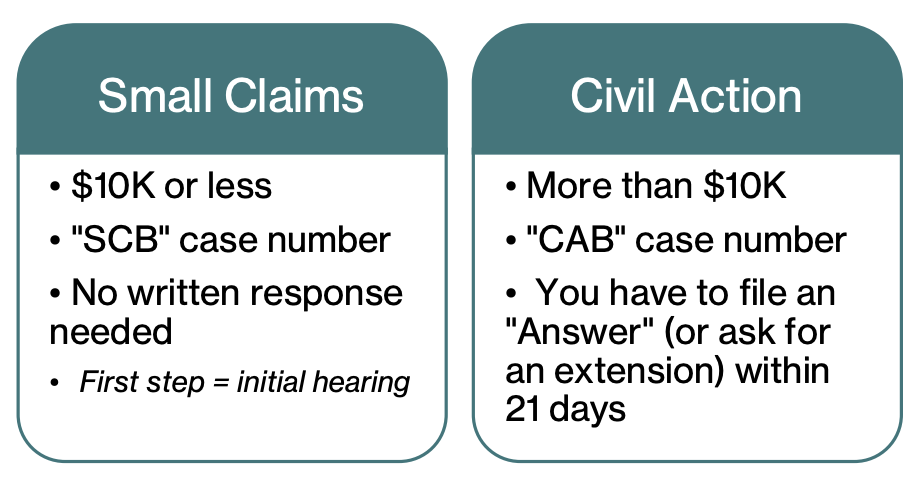
In a small claims case, the plaintiff files a “Statement of Claim” instead of a Complaint. You can, but you are not required to file an “Answer” (a written response) in a small claims case. Your next step would be attending the Initial Hearing.
In a civil actions case
You can tell your case is a civil actions case if the case number has a “CAB” in it (CAB stands for Civil Actions Branch). If the amount you’re being sued for is more than $10,000, it will be a civil actions case.
In a civil actions case, you need to file an “Answer” to the Complaint. The Answer is due 21 days from the date you were served with the court papers. But you can ask the court to extend the deadline for your Answer, either by filing a “motion” (a request to the court to do something) or by asking the judge for an extension at a hearing. You should ask before your 21 days run out.
In an Answer, you are supposed to admit or deny each of the facts stated in the Complaint. Usually, the facts are stated in numbered paragraphs, and you can respond using the same numbering. Or you can just say you don’t have enough information to admit or deny a fact. You don’t need to respond to statements about the law.
If you have a defense you want the court to know about (for example, that you already paid the debt or that it isn’t your debt), you can put that in your Answer. If you believe the plaintiff broke a law or owes you something, you can also state your own claim against the plaintiff in your Answer. That is called a “counterclaim.”
You can find “Answer” forms on the court’s website at dccourts.gov/courtresources by searching “civil answer.”
At the first hearing in your case, the judge will ask whether you consent (agree) to have a Magistrate Judge make decisions in your case. For more information about Magistrate Judges and consenting to a Magistrate Judge, see below. The judge may also ask you whether there are any problems with service of the court papers. For example, you may have come to court because you received a court notice of the hearing. But you can still say you want to be served with the court papers.
If you agree to have the case heard by a Magistrate Judge and there are no problems with service, the judge will usually schedule a “mediation” as the next step in the case. A mediation is a “virtual” or “remote” (by video) meeting with a mediator who works for the court. Mediators are not decision-makers like judges; they are neutral and help the parties try to settle the case by reaching an agreement. For more information about mediations, see the "Mediation and Settlement" section below.
The court also schedules a post-mediation hearing so the judge can find out what happened at mediation
Most hearings in DC Superior Court’s Civil Division are “remote.” You and the other party can participate in a remote hearing by calling a phone number or using a video link (currently using WebEx). You will then be able to hear and (if connected by video) see the judge and other parties in your case.
There are instructions for how to connect by phone or video in each hearing notice that the Court sends (usually by mail). If you’ve given the Court your email address or used the Court’s electronic filing system, you also may receive hearing notices by email.
If you prefer, you can participate in person at the main courthouse at 500 Indiana Ave. NW, on the second floor. The court notice will give you a specific courtroom number. Most debt collection hearings take place in courtroom 205.
A Magistrate Judge is one type of judge at DC Superior Court. All judges at the courthouse use the same law and apply it the same way.
Most debt collection cases are assigned to the court’s Debt Collection Calendar. On that calendar, a Magistrate Judge is assigned to hear and make decisions in your case.
There are two big differences between Magistrate Judges and the other type of judge, called an Associate Judge:
- The first is that Magistrate Judges cannot preside in jury trials, so if you want
a jury to decide your case, you need to ask for an Associate Judge. - The other big difference is how appeals work. If you disagree with the final decision of a Magistrate Judge, the next step is to ask an Associate Judge to review the decision. If you lose again, you may be able to appeal the final decision made by an Associate Judge to the DC Court of Appeals.
There could also be strategic reasons to have your case heard by an Associate
Judge. This will likely delay your case, so you should speak with an attorney before making that decision.
The court can find you in “default” (a failure to respond or participate) in a civil actions case if you did not file an answer to the complaint on time (21 days after service). (No answer is required in a small claims case.) In any kind of case, the court can find you in default if you didn’t go to a scheduled court hearing after you were served.
When there is a default, the court usually schedules what is called an “ex parte proof” hearing. That is a hearing where the court can go ahead without you and allow the plaintiff to show how much you owe. If that happens, the court may then enter a “default judgment” against you for the amount the plaintiff proved you owe. A “judgment” is a final court action in the case.
You have the right to ask the court to “vacate” (undo) a default. One way to do that is to participate in the next court hearing to explain why you didn’t answer the Complaint or participate in a prior hearing. You also have the right to ask the court to vacate a default judgment. That is best done in a written motion.
You can get free information and advice about vacating a default judgment by calling the DC Resource Bridge at 202-933-HELP (4357) or applying for legal help from one of the organizations listed in the "Getting Legal Help" section.
The court’s website has information about representing yourself, forms you might need, court rules, the electronic filing system, and much more at www.dccourts.gov.
The most important information on the court’s website is the official record in your case called the “docket.” To see the docket, go to the Court’s website, www.dccourts.gov, and select “Search Cases Online.” The docket lists every filing, hearing, and court notice in your case. You can view and download the filings. You can also get information about your case by calling or visiting the Clerk’s Office (see info on the left).
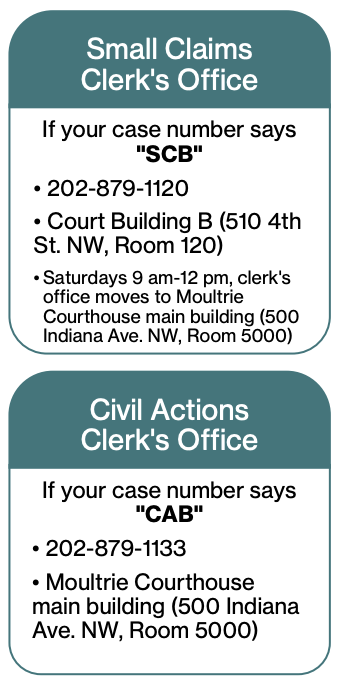
You can file papers in one of three ways:
- Go to the clerk’s office and file in person.
- Mail your documents to the clerk’s office.
- Use the court’s online filing system.
To use the court’s online filing system, you must first register and set up an account at dccourts.gov/superior-court/file-online-efiling#civil.
You should try to find a lawyer to represent you. Many defendants in debt collection cases qualify for a free lawyer. Even if you believe you owe the debt, you are likely to get a better outcome, such as a better settlement, with a lawyer. See the "Getting Legal Help" section above for information about finding a lawyer.
If you decide to represent yourself, the court’s website has resources, including handbooks for people representing themselves. You can explore these resources at www.dccourts.gov/superior-court/superior-court-divisions/civil-division.
There are charges for filing some kinds of papers, like motions (which cost $10 for small claims and $20 for civil actions). If you use the electronic filing system, there is also a service fee.
But you are eligible to obtain a waiver of all fees and charges if you receive public assistance (e.g., Medicaid, SSDI or SSI, TANF, SNAP, and housing assistance) or if you have low income. You can apply for a fee waiver at the same time as you make your first filing and the clerk will not ask for a fee while your application is pending. You can download the Fee Waiver Application and other forms from the court’s website at dccourts.gov/court-resources.
- In small claims cases, there are no papers you are required to file up front. If your case goes to trial, you’ll be able to file documents you want to show in court.
- In civil action cases, you are required to file an Answer to the Complaint. See Section 4 for information about preparing an Answer.
- In all cases, there might be “legal” reasons why you should win. For example, you may be able to show the judge that the case against you was filed after the statute of limitations expired. In this situation, you may be able to file a “motion to dismiss” or a “motion for summary judgment” and request that the court dismiss the case or rule in your favor.
Mediation is usually the next step in a case after your Initial Hearing. At mediation, a mediator tries to help the parties resolve the case (also called “settling” the case or a “settlement”). The mediator is not a judge and cannot make any decisions in your case. The mediator’s only job is to help parties reach an agreement without having to go to a trial.
Before your mediation, you will receive instructions for how to join the mediation. If the court has your email address, these instructions are provided by email.
All mediations at DC Superior Court are currently handled remotely on Zoom. If you want to attend the mediation in person, you have to let the court know ahead of time. You must submit an application to attend the mediation in person within 24 hours of getting the mediation scheduling email. You can find this application at dccourts.gov/court-resources/search-forms by searching “remote mediation.”
Before your mediation, you will be sent an “agreement to mediate” that includes information about mediation such as the role of the mediator, that the mediation is confidential, and that mediation is optional.
The mediation will be attended by all parties in your case, their attorneys (if they have them), and the mediator. If the other party is a corporation (like a bank), someone with the power to make decisions for the corporation will attend.
At mediation, the mediator will usually ask both parties to propose a solution and then try to find common ground. The plaintiff will generally start by stating why they sued you and the amount of money they say you owe them. If you disagree with the amount or have other defenses to the claim, you can explain that. Or, if you believe you owe at least some of the debt, you can offer to resolve your case by paying less than the amount the plaintiff says you owe. You can ask the other side for information during the mediation. You can also provide information. For example, if you dispute the amount that the plaintiff says you owe, you can show documents that support your position during mediation. You can show it to the other side to help reach an agreement on how much you owe
them.
The mediation process is confidential. This means that no one who attends the
mediation (including the mediator) can talk about what happens in mediation during other proceedings in the case, including trial.
You do not have to reach an agreement (a “settlement”) at mediation. If you don’t agree to settle, you will not lose your right to defend your case or to have a trial.
If you owe a debt that you can’t pay all at once, you may be able to reach an agreement with the plaintiff to pay over time, generally in monthly installments. The mediation process is a helpful way to reach a settlement agreement.
In a settlement agreement, you may be able to:
- Reduce the amount you owe. Many plaintiffs will agree to a settlement where you agree to pay less (sometimes much less) than the amount they say you owe.
- Set up a payment plan. Some plaintiffs will agree to let you pay your debt back over time. You can negotiate terms of the payment plan that work for you and your finances. When you agree to a payment plan, the first step is to agree on the total amount you will pay as a settlement. Once you have that number, you can try and negotiate:
How much you will pay each month. Make sure that you agree to a monthly payment that you are certain you can keep up with. If you miss a payment, the plaintiff can ask for a judgment against you.
When your payments start. If you need time to plan for the first payment, you can ask that your payments start at a future date.
When your payments are due (for example, the first, middle, or end of the month).
A settlement will also explain what happens if you don’t uphold your end of the agreement. It will say that if you “default” (you don’t pay as agreed), the plaintiff can ask the court to “enter” (issue) a judgment against you. This usually means that if you don’t pay what you promised to pay on time, the plaintiff can ask the court to enter judgment for the full amount of their original claim (minus what you paid so far) even if you settled for a lower amount.
If you receive government benefits (like Social Security), your income may be
protected from debt collectors and it may not be in your interest to offer to pay anything, even if you owe the money. If you think your income may be protected, talk to an attorney before agreeing to a payment plan.
An important factor to consider in settlement is what would happen if the plaintiff obtained a court judgment against you. The impact of a judgment against you depends on multiple factors.
If your source of income is from Social Security, disability, a pension, or some other form of government benefit, or you have only minimum wage income from your job, your income may be protected from collections. That means that the party suing you won’t be able to get money from you, even with a court judgment. Some other kinds of money and property (including your home, if you own one) are also protected.
If your income and property are not protected, a plaintiff that gets a judgment against you may be able to take a portion of your paycheck or bank account directly from your employer or your bank.
Whether your income and property are protected from creditors is an important consideration in any settlement. More information about protected income and property is available on the Court’s website, dccourts.gov/superior-court. You can find more details at dccourts.gov/court-resources/search-forms by searching “garnishment.”
Even if you believe you owe some or all of the debt, you do not have to settle.
- One reason not to settle is if you have defenses to the plaintiff’s claim. For example, if the statute of limitations has expired (they sued you too late), the plaintiff’s claim should be dismissed — regardless of how much money you may otherwise owe.
- Or you may believe the plaintiff can’t prove you owe the debt. When you are sued, the plaintiff has the “burden of proof” (they must have evidence to support their claims).
- Another reason to have a trial is that you may have your own claims against the plaintiff. Such claims are called “counterclaims.” You could have a counterclaim because the plaintiff violated debt collection laws in the way they tried to collect the debt. See the "Your rights under the DC Debt Collection Act" section for more on this. If you think that the person or business violated the law when they attempted to collect from you, consult an attorney to help you file your counterclaims.
No. It is your decision whether you want to settle your case. If you can’t reach a settlement agreement that is acceptable to you at your mediation, you can still settle later. In the meantime, the court will set a schedule for further events in your case.
If you cannot make a payment, you should contact the plaintiff as soon as possible and try and work out another option. The plaintiff might allow you to pause your monthly payments, or pay a lower amount, until you are able to return to the original schedule. Or the plaintiff may be willing to renegotiate a payment plan so that it is affordable. But the plaintiff is not required to do these things.
If you miss a payment, the plaintiff could ask the court for a judgment against you for the entire amount stated in their original claim (minus whatever you paid under the settlement).
If the plaintiff gets a judgment from the court, they can try to collect the money from you. They can take some of your wages if you earn enough money. They may also be able to take money from your bank account.
In many debt collection cases, the creditor has already reported the account to the credit reporting agencies as an “adverse” (bad) account or an account in collection. Such accounts have a negative impact on your credit score. They remain on your credit reports for seven years from the time when the account became delinquent (you stopped paying on time).
A payment plan settlement is not likely to have much impact on your credit score. Once you finish paying the agreed settlement amount, though, the creditor will be required to update its credit reporting to show that the account was settled and satisfied. That may have some positive impact on your credit score because the account is no longer showing an amount due.
In a civil actions case, if you do not settle the case at your mediation, the court will issue a scheduling order listing the next events in the case. The scheduling order lists deadlines for making and responding to requests for information and documents.
This is your opportunity to request the other side to produce documents and to answer your written questions (called interrogatories) under oath. For example, you could ask the plaintiff to give you the documents they say support their claim or to identify the witnesses they plan to ask to testify at trial. They can also ask you for documents and responses to questions. The process of exchanging this kind of information is called “discovery.”
There is no right to discovery in a small claims case. But you can ask the court to allow you to obtain discovery from the plaintiff. You can do this at a hearing in your case or in a written motion. The court generally grants those requests.
After discovery is completed, each party can file motions to try to decide the case without having a trial. (One such motion is a motion for “summary judgment”). A motion for summary judgment signals to the court that the parties may agree on the legally important facts of the case and asks a judge to make a decision based on that information.
Otherwise, the last step is a trial.
Unlike initial hearings (which are done by phone or video), your trial will be in person in the main courthouse building at 500 Indiana Ave. NW.
You should arrive for your trial at least 15 minutes before the scheduled time.
When the court calls your case, the judge will ask the parties whether they are ready to start the trial. Sometimes there are issues the court needs to discuss with both parties before beginning. For example, one of the parties may have filed a motion (a written request to the court) that the court needs to consider.
When the trial begins, the judge may ask both you and the plaintiff or their lawyer for an “opening statement.” An opening statement is each side’s opportunity to introduce their arguments. Your opening statement is not evidence. It is to tell the judge about the evidence you will be presenting.
After opening statements, each side will present its evidence (testimony from witnesses and documents). The plaintiff goes first. They will generally call a company representative such as a collection manager to say how much you owe. They will also have documents that they will ask the judge to admit in evidence, so the judge can consider them when deciding the case. Their documents might be your credit application or a contract (like a lease), your account statements, and a history of the transactions in your account. Some or all those documents may have been included with the Statement of Claim or Complaint that the plaintiff filed to start the case.
You go second. You will also have an opportunity to call any witnesses, to testify yourself, and to ask the judge to admit your documents in evidence. If you are contesting the debt, it will be important to have documents supporting your position.
In a small claims case, the court may ask both parties to submit their documents to each other and the court before the trial. Listen carefully for any instructions the judge gives about how to do this. In most civil action cases (for claims over $10,000), the court will usually have a hearing called a pre-trial conference to discuss exchange of exhibits and final witness lists.
When both sides finish presenting their evidence, the judge may ask each side to make a “closing statement.” That is your opportunity to summarize your defenses and your evidence and explain why you should win.
Make sure to bring to court any witnesses who can support the facts you want to prove. If necessary, you can ask the clerk’s office to issue a subpoena to a witness you want to testify. If you need to subpoena a witness, you must do that well before your trial date.
You also need to bring any documents that support your defense with you to the trial. Unless you’ve already submitted your trial exhibits to the other side and the court in advance, you should have three copies of each document (one for the judge, one for the other side, and one for yourself).
If your case is a small claims case, the usual “rules of evidence” (what is required to have testimony or an exhibit considered or excluded) are relaxed. But if your case is a civil actions case (the plaintiff is suing you for more than $10,000), the judge will apply rules of evidence that govern what a witness is allowed to testify about and what documents can be considered by the court.
The judge in your case may announce an oral (out loud) decision at the end of the trial. Or the judge may issue a written decision later (usually within a week or two). If the decision is a written decision, you will receive a copy in the mail or email (depending on whether you’ve signed up for the court’s e-filing system).
The final decision is called a judgment. If you win, it will be a judgment for the defendant. If the plaintiff wins, it will be a judgment against you for a specific amount of money.
If the court issues a judgment against you, your time to “appeal” (contest) the judge’s decision will begin to run right away. The appeal times and process are different in small claims and civil actions cases and can be complicated.
- If your case was a small claims case, you have only 14 days to file a motion for review, asking an Associate Judge to review the Magistrate Judge’s decision for errors.
- In a civil actions case, you must file a notice of appeal within 30 days. If you want to appeal, you should consult a lawyer.
In the next section, you can learn about how the plaintiff may attempt to collect the judgment against you.
If the company or person suing you gets a judgment against you, they can try to collect the judgment amount from you. You do not have to pay the judgment voluntarily. The plaintiff must take steps to collect it. You cannot be arrested or jailed for not paying a consumer debt, even if there’s a court judgment against you.
The two main ways the plaintiff can try to use a judgment to collect from you are by making your employer give them some of your wages (“wage garnishment”) and making your bank give them some of the money in your account (“bank attachment”). Once the plaintiff in your case gets a court judgment, they become a “judgment creditor.”
You may be able to protect your wages and your other money from a judgment creditor. Wage garnishments and bank attachments can present complicated legal issues. You can try to find a free lawyer about a wage garnishment or bank attachment by calling the DC Resource Bridge at 202-933-HELP (4357).
Sometimes a plaintiff might obtain a “default judgment” against you. That happens if you did not participate in the court case or stopped participating. It could also happen if you didn’t know about the case because you were never properly served (see the "First Steps" section for more about proper service). If the judgment that someone is trying to collect against you is a default judgment, that is another reason to talk to a lawyer.
Wage garnishment starts when a judgment creditor obtains a court paper called a “writ of attachment for wages” and serves it on your employer. Your employer is then required to comply with DC’s wage garnishment law.
If you live in DC but work in another state, there may be complicated issues about which state’s wage garnishment law applies. Another issue can arise if a plaintiff has obtained a judgment against you in another state but tries to collect it from you in DC. Or the plaintiff may serve your employer at the employer’s location in another state. In any of these situations, you should talk to a lawyer.
Under the District’s wage garnishment law, a judgment creditor cannot take any of your wages unless your weekly pay (after required deductions like tax deductions) is at least 40 times the District’s minimum wage. As of July 1, 2026, the minimum wage is $ $18.40 an hour. Unless your after-tax money is at least $736 per week ($1,472 if you are paid every two weeks or $38,272 per year), you are protected from wage garnishment.
Any wages you make over that minimum wage limit can be “garnished” by 25%. So, if you make $836 per week after taxes, $100 of that is unprotected, and the judgment creditor could take $25 out of your weekly paycheck.
Even if your after-tax money is over the protected amount, you can still file a motion with the court to protect more of your money if you can show that garnishment would result in financial hardship. You can find the needed form on the court’s website at dccourts.gov/court-resources/search-forms by searching “garnished wages.”
Another way a judgment creditor can take your money is with a bank attachment. As with wage garnishment, a bank attachment starts when a judgment creditor obtains a “writ of attachment (for other than wages)” and serves it on your bank. The bank is then required to hold the funds in your account until the judgment creditor takes steps to have the bank turn over your money to them.
One important exception, though, is that the money in your account may come from an “exempt” source, meaning a source legally protected from a judgment creditor. Exempt sources include all forms of Social Security, including retirement and disability money. Pensions are also exempt.
When the judgment creditor serves the writ on your bank, they must also send a copy to you along with a court paper that explains in detail what types of money are exempt.
If there is a disagreement about whether your bank should give the judgment creditor your money, you also have the right to file a motion with the court to prove your money is exempt.
You can find these forms on the court’s website at dccourts.gov/courtresources/search-forms by searching “exempt funds.”